
In two minutes: what to remember
- Odds are a price, not a prediction. You can convert them into an implied probability, but that number still includes the operator’s margin and market uncertainty.
- Use examples, not “current” screenshots. Cricket prices move quickly — especially in-play — so treat any quoted number as time-sensitive.
- Before you compare anything, verify licensing in GB. The Gambling Commission recommends checking businesses via its public registers.
- Expect checks. In Great Britain, online gambling businesses must verify age and identity before a customer can place bets, and may ask for financial information in some cases.
- Know the safe escalation route. The Gambling Commission describes a complaints path that can end with an Alternative Dispute Resolution (ADR) provider after a waiting period.
- If gambling is starting to feel hard to control, get support early. There are UK services for confidential help and tools like self-exclusion.
UK vs Great Britain: a quick note
This site is written for Great Britain (England, Scotland and Wales), where the Gambling Commission regulates gambling. Rules and services can differ in Northern Ireland. If you are in Northern Ireland, treat any GB-specific guidance as a starting point and verify the local position separately.
What “cricket betting odds” usually means in Great Britain
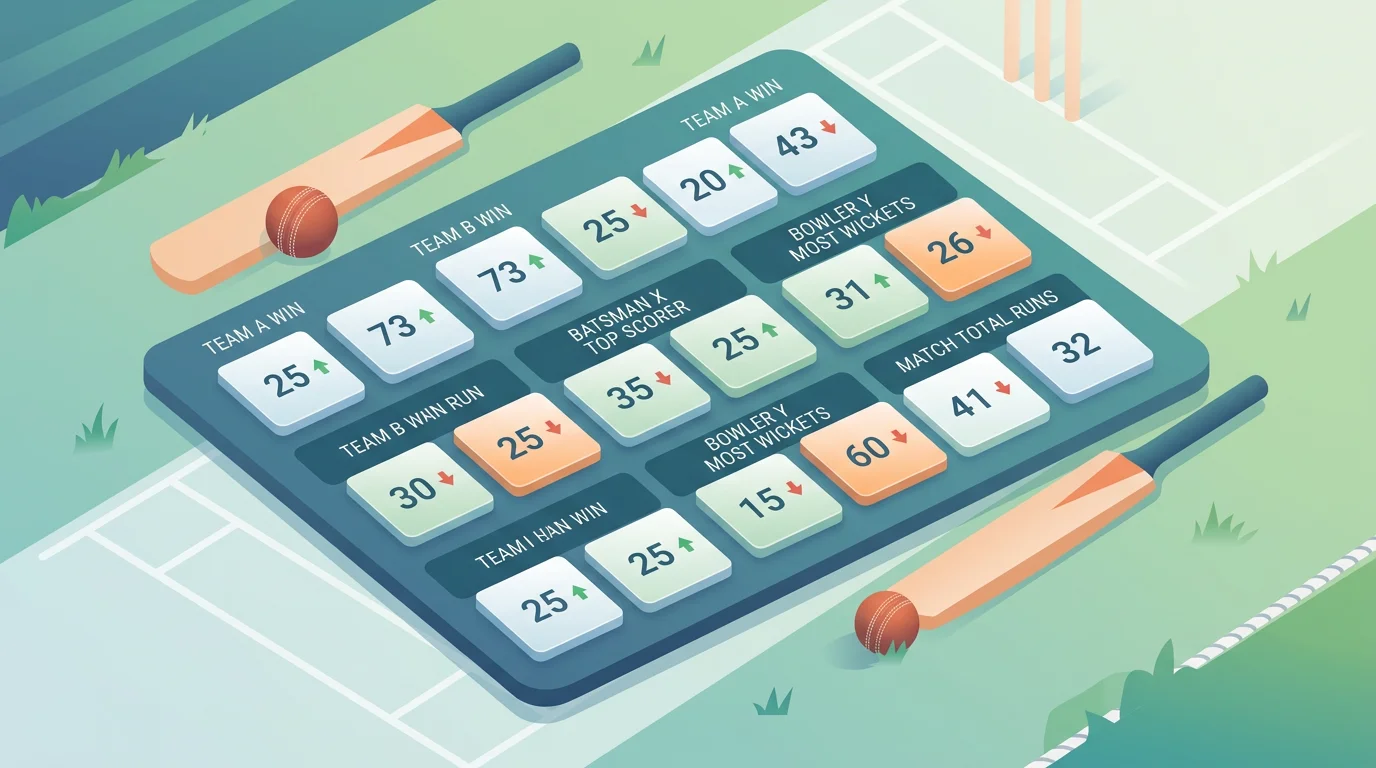
In everyday UK usage, odds are the numbers that describe the price you’re offered for a specific outcome — for example, a team to win a match, a player to be top run-scorer, or a total runs market. When people search for cricket odds, they are often trying to do one of three things:
- Understand the numbers. What does “7/4” actually mean? How is it different from “2.75”?
- Compare prices safely. If two regulated businesses offer different prices, which one is better for the same market — and how do you check they’re legitimate in GB?
- Know what could go wrong. Verification requests, payment restrictions, misleading promotions, or disputes about how a market is settled.
This hub focuses on the parts you can control: reading odds correctly, understanding what the price implies, and checking the essentials (licensing, terms, safer gambling tools, dispute routes, and security) before you act. It does not contain predictions, tips or “systems”.
A useful mindset for odds
Think of odds as a quote at a moment in time. If you see a number in a message, a screenshot, or a forum post, treat it like a train timetable from last week: it might still be “roughly true”, but it’s not something to rely on without checking the original source.
Cricket · player and phase markets
Batsman Runs & Powerplay Calculator
Match odds are only part of the card. The markets where prices drift furthest from the maths are individual batsman runs and phase totals — powerplay runs and runs off a single over. Enter the numbers you already know and get the fair price for each line.
Milestones
Runs over/under
Cricket scores follow a memoryless pattern surprisingly well: a batsman is roughly as likely to be dismissed on any given ball, so scores fall away exponentially. The practical consequence is that the average alone drives every milestone — and that a set batsman on 40 is no more "due" a dismissal than one on 4.
Phase total over/under
Runs in a single over
Phase markets are far more volatile than the match total, because a single over can swing them by twenty runs. That volatility is why the variation slider matters as much as the run rate: two sides with the same expected rate can have very different odds on the higher lines if one of them plays a boundary-or-nothing game.
For information only; a simplified statistical model with no guarantee, ignoring pitch, conditions and match situation. Gambling can be addictive — please play responsibly. 18+. Free, confidential help: BeGambleAware.org or the National Gambling Helpline on 0808 8020 133.
Fractional vs decimal odds (with worked examples)
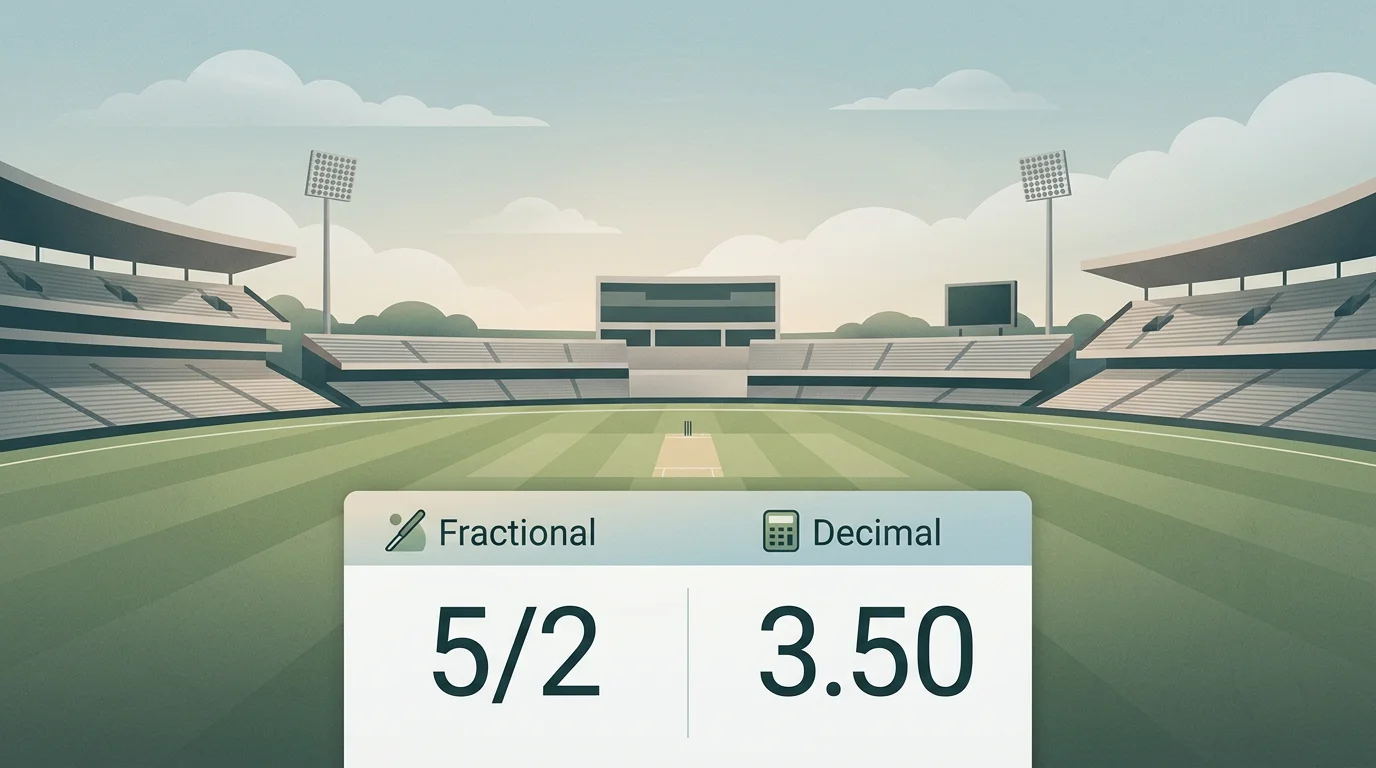
In Great Britain, fractional odds (like 5/2) are still very common. You’ll also see decimal odds (like 3.50), especially on apps and comparison tools. Both formats describe the same thing; they just package it differently.
Fractional odds
A fraction like 5/2 means you win £5 profit for every £2 staked, plus you get your stake back if the bet wins.
In other words: profit ratio first, stake returned separately.
Decimal odds
A number like 3.50 represents the total return for each £1 staked (including the stake). To get profit, you subtract the stake.
In other words: total return factor.
| Example odds | Stake | Profit if it wins | Total return | Implied probability |
|---|---|---|---|---|
| 1/2 (decimal 1.50) | £10 | £5 | £15 | ≈ 66.7% |
| 7/4 (decimal 2.75) | £10 | £17.50 | £27.50 | ≈ 36.4% |
| 5/2 (decimal 3.50) | £10 | £25 | £35 | ≈ 28.6% |
| 10/1 (decimal 11.00) | £10 | £100 | £110 | ≈ 9.1% |
The table above uses simple “win/lose” examples to show the relationship between formats. Cricket markets can be more nuanced (for example, what happens if a match is abandoned or shortened), so always read the settlement rules for the market you’re looking at. A safe habit: if you don’t understand exactly how a market is settled, don’t treat the odds as meaningful information.
Key takeaway
If you see fractional odds, convert them once or twice on paper and the format stops feeling mysterious. After that, the more important questions are practical: Is this a GB-licensed business? What are the rules and checks?
Implied probability: useful, but not a forecast
Converting odds into an implied probability can be helpful because it forces you to understand what the number means. The key is to treat it as a translation, not as a prediction.
Quick formulas
- Decimal odds → implied probability: 1 ÷ decimal
- Fractional odds a/b → implied probability: b ÷ (a + b)
Example: decimal 3.50 → 1/3.50 ≈ 28.6%. Fractional 5/2 → 2/(5+2) ≈ 28.6%.
What implied probability can and cannot tell you
It can help you:
- Compare two prices for the same market in a consistent way.
- Spot when a market is priced as “more likely” vs “less likely”.
- Notice when a small odds change is actually a big probability change (or vice‑versa).
It cannot do for you:
- Predict what will happen in the match.
- Remove uncertainty (weather, toss, injuries, team changes, and live momentum still matter).
- Tell you the “true” probability — because the price usually includes a margin and risk management.
If you ever total the implied probabilities across all outcomes in a market, you may find the sum is higher than 100%. That is one reason “implied probability” is not the same thing as “objective probability”. For most readers, the practical message is simple: use the conversion to understand the odds — not to convince yourself that a bet is “certain”.
Why odds move (pre‑match and in‑play) — in plain terms
Odds move when the market’s picture of the match changes. Sometimes that change is driven by public information, sometimes by how money flows into a market, and sometimes by how the business manages risk. In cricket you’ll often see movement around:
- Team news and player availability (late changes matter more than you might expect).
- Pitch and weather (conditions can swing expected scoring patterns).
- The toss (many markets reprice quickly once it’s known).
- Format and context (Test vs ODI vs T20 affects volatility).
- Live match events (wickets, run rate shifts, overs remaining, target pressure).
A quick risk map: when prices are easiest to misread
Lower confusion risk
Pre‑match prices viewed directly on the operator’s site, with settlement rules open in another tab.
Medium confusion risk
Aggregators and “comparison” views where markets look similar but have different settlement wording.
Higher confusion risk
In‑play prices from screenshots, group chats or social media, where the market state may have changed seconds later.
This isn’t a judgement about “good” or “bad” betting — it’s simply about how easy it is to misunderstand what a number refers to.
If you’re checking odds mainly to satisfy curiosity or to follow a match, you can keep things safer by slowing down: avoid making decisions in the heat of rapid in‑play swings, and treat any live number as “valid only right now”.
Before you compare prices: check GB licensing first
In Great Britain, the most important trust signal is whether the business is licensed by the Gambling Commission. The Commission advises the public to make sure a gambling business is licensed and provides public registers you can use to check details yourself. See: Gambling Commission guidance on checking licensing and the public registers hub.

A practical self‑check (no special tools needed)
- Open the Register of gambling businesses. Use the search to look up the business name, trading name, or website domain.
- Confirm the listing matches what you’re looking at (names can be similar). If the register shows a website domain, check it carefully — scammers rely on look‑alike domains.
- Check the licensed activities shown in the register are relevant (for example, betting). If you can’t find the business or the details don’t line up, treat it as a red flag.
Safe comparison checklist (before you deposit)
- Licence: verified in the Gambling Commission register (GB).
- Market clarity: you can find settlement rules for the exact cricket market you’re viewing.
- Significant terms: promotion terms are clear and not buried (if any promotion is involved).
- Safer gambling tools: deposit limits, time‑outs or self‑exclusion are easy to find.
- Complaints route: the complaints process and ADR route are visible in the help pages.
- Security basics: you know the exact domain/app, and you’re not relying on a link from a message.
The Commission also warns that unauthorised businesses may use false names, addresses and contact numbers. If something feels “off”, go back to the register first rather than trusting contact details on the site itself. (See: Gambling Commission scams and fraud guidance.)
Want the full walk‑through? See the dedicated page: How to check a betting site is GB‑licensed (step by step).
Promotions and “free bets”: what to check (without loopholes)
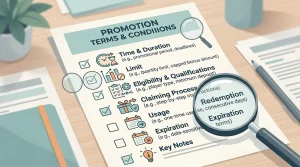
Promotions can change how a bet is priced and settled, so it’s worth checking the terms before you accept anything. In Great Britain, the Gambling Commission expects terms and practices to be fair and transparent. (See its transparency guidance: Fair and transparent terms and practices.)
A practical way to stay grounded is to separate two questions: What do the odds mean? and What conditions are attached to this offer? The second question is where misunderstandings are common.
Common promotion checks (neutral checklist)
- Eligibility: new customers only, location limits, or account verification required first.
- Expiry: how long you have to use the offer once it’s granted.
- Minimum odds / market limits: sometimes only certain markets qualify.
- Stake and returns: whether the stake is returned and what parts of a return can be withdrawn.
- Maximums: caps on stake size, winnings, or withdrawals linked to the offer.
- Cancellation rules: what happens if a cricket match is abandoned or shortened.
The exact wording varies by business. The checklist above is about what to look for — not about “how to beat” the terms.
As an example of why terms matter, the Gambling Commission has announced changes aimed at making gambling promotions “safer and simpler”, including restrictions around mixed-product promotions and a cap on wagering requirements. The Commission states these changes took effect on 19 January 2026. See: Gambling promotions to be safer and simpler.
For a deeper, terms‑focused guide (still brand‑neutral), use: Bonuses and promotions: what to check before you accept.
Payments in Great Britain: credit cards, withdrawals and balance risk
Credit cards
In Great Britain, the Gambling Commission introduced a ban on using credit cards for gambling. The Commission provides guidance for licensees on preventing credit card use and describes where the ban applies and where exceptions exist. See: Preventing credit card use and the Commission’s 2020 announcement: Gambling on credit cards to be banned.
For most readers, the day‑to‑day implication is simple: if you try to deposit with a credit card in a GB‑licensed context, it should not be accepted. If a site encourages credit card gambling, treat that as a serious warning sign and check licensing again.
Customer funds: what “protected” means (and what it doesn’t)
If you keep money in an account balance, it can help to understand how customer funds are handled if a business becomes insolvent. The Gambling Commission requires licensed businesses to explain to customers how funds are protected and to obtain confirmation that the customer has seen this information. See: Protecting customer funds.
At a glance: balance risk in plain English
- Protection levels vary by category, and “protected” is not the same thing as a bank guarantee.
- Money tied up in open bets is not treated as customer funds for insolvency protection purposes, according to Gambling Commission guidance. See: Guidance on assessing whether you hold customer funds.
- If you don’t need to keep a large balance, keeping only what you intend to use can reduce exposure.
If you want to understand the category system in more detail, the Commission explains the customer funds insolvency ratings framework here: Customer funds insolvency ratings system.
For a practical GB‑focused overview of payments and common checks (without brand claims), see: Deposits and withdrawals in GB: what to expect and what to check.
Age, ID and financial checks (KYC): why it happens
Verification is one of the biggest sources of frustration for people new to regulated betting — but in Great Britain it’s also a core safety mechanism. The Gambling Commission states that online gambling businesses must ask customers to prove their age and identity before they can place bets. Until a customer is verified, they cannot gamble. See: Age, ID and financial verification (Gambling Commission).
What you may be asked for
The Commission gives examples of documents that may be requested, such as a passport, driving licence, or utility bill. Think of these as examples, not a fixed checklist — different businesses and situations can require different evidence.
A calmer way to approach verification
- Expect the request early. In GB, verification is not “optional admin”; it’s part of the rules for online gambling.
- Use official channels. Upload documents only through the business’s official site/app — not via links from messages or emails you didn’t ask for.
- Keep records. If you are in a dispute later, having a clear timeline of what you submitted and when can help.
- If finance questions appear, don’t panic. The Commission explains that businesses may ask about finances to support anti‑money‑laundering checks and to prevent harm. See: Why gambling businesses want to know about your finances.
Privacy: what to do if you feel your data is mishandled
If you believe your personal data has been used incorrectly, GOV.UK advises first contacting the organisation directly. If you’re not satisfied with the response, you can make a complaint to the UK Information Commissioner’s Office (ICO). See: GOV.UK data protection complaint guidance and ICO: make a complaint.
Want a dedicated, step-by-step explanation (including what to prepare in advance)? Use: Age, ID and financial checks explained.
If something goes wrong: complaints → ADR (and the boundaries)
Disputes tend to fall into a few buckets: settlement disagreements, account restrictions, verification delays, or confusion about promotion terms. Whatever the trigger, a safe way to proceed is to follow the route described by the Gambling Commission: start with the business’s own complaints process, then escalate if needed. See: Taking your complaint to an ADR provider (Gambling Commission).
A practical escalation path
- Step 1 — complain to the business. Use its formal complaints channel and keep copies of what you send.
- Step 2 — wait for the internal outcome. The Commission notes that if a complaint is unresolved after 8 weeks, you can take it to an ADR provider.
- Step 3 — ADR. ADR is independent and free to use. Once the ADR provider has all the information it needs, the Commission indicates it normally has up to 90 days to reach a decision.
These are the Commission’s general time markers and process notes — not a promise of a particular outcome in any individual case.
What ADR is (and what it isn’t)
The Commission’s ADR guidance also explains important boundaries. For example, it notes that ADR will not deal with complaints about a business refusing to accept a bet or certain customer-service issues — businesses can decide whose bets to accept and on what terms. Knowing this boundary helps you focus on disputes ADR is designed to handle.
The Gambling Commission maintains a list of approved ADR providers here: Approved ADR providers (Gambling Commission). Because the list can change, it’s safer to use the official page rather than relying on copied lists elsewhere.
For a dedicated guide with examples of what to include in a complaint, see: Complaints and ADR in Great Britain.
Safer gambling tools and support
Cricket betting odds can be interesting to follow — but gambling can also become hard to control, especially when it is fast, always available, and emotionally tied to live sport. Safer gambling is not about judgement; it’s about putting friction in the places where impulse tends to win.
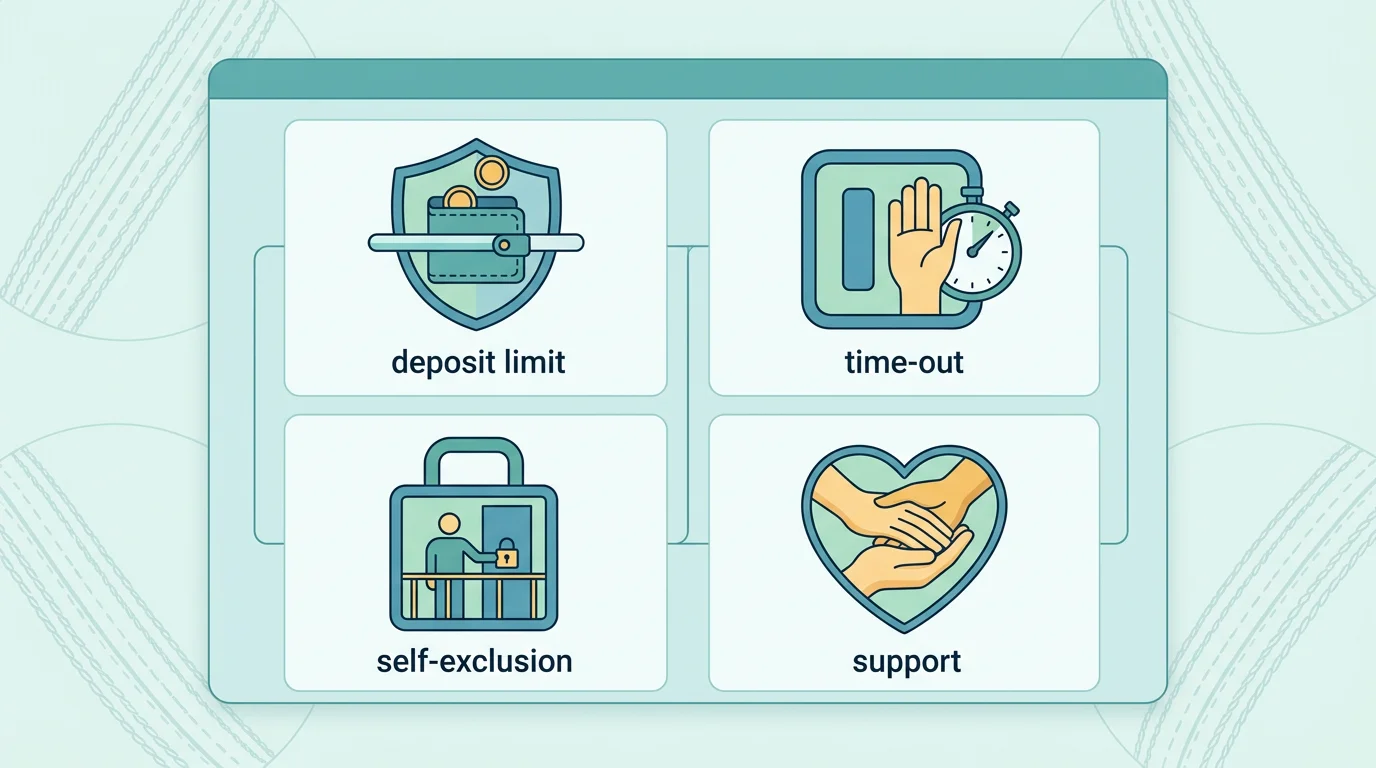
Tools you can usually control
- Deposit and loss limits (set numbers you are comfortable with before you bet).
- Time-outs (a short break that blocks betting for a defined period).
- Self-exclusion (a longer, formal stop).
- Bank transaction blocks (some banks offer blocks for gambling transactions; details vary and can change).
The Gambling Commission lists free national and multi‑operator self‑exclusion schemes and points to support resources. See: Free multi‑operator and national self‑exclusion schemes. For online self‑exclusion in Great Britain, it also provides guidance on GAMSTOP: Self‑exclusion with GAMSTOP.
For bank blocks specifically, the Commission provides a general explainer here: How to block gambling transactions — it’s intentionally high-level, because features differ by bank and can change over time.
If gambling is affecting you
If you feel you’re spending more time or money than you intended, getting support early can make a real difference. UK services include:
- GamCare (National Gambling Helpline) — confidential support and advice.
- GambleAware — information and a directory of support options.
- GAMSTOP — online self‑exclusion for Great Britain.
- MoneyHelper — guidance on problem gambling and debt, and where to get financial support.
For personal medical or mental health support, consider speaking with a GP or local services in your area.
For a detailed explanation of tools (including what they do and what they don’t), use: Safer gambling tools and support in the UK.
Scams, phishing and staying safe online
Scams in gambling often exploit urgency: “limited offer”, “account problem”, “click now”, “verify now”. The Gambling Commission warns that unauthorised businesses may present fake names and contact details, and recommends checking licensing through the public register rather than trusting what a site claims on its own pages. See: Scams and fraud (Gambling Commission).

Phishing: what it is and how to handle it
The UK National Cyber Security Centre (NCSC) describes phishing as fake messages, websites or calls designed to trick you into revealing information or sending money. Their guidance focuses on practical recognition and reporting. See: NCSC phishing advice.
Do
- Type the known website address yourself (or use a trusted bookmark) instead of clicking a message link.
- Check the domain carefully — scammers often use look‑alike spellings.
- Use multi‑factor authentication when it’s available.
- Report suspicious emails and websites via GOV.UK. See: Report phishing on GOV.UK.
Don’t
- Enter passwords or payment details after following a link from an unexpected message.
- Share one‑time codes (MFA/2FA codes) with anyone — legitimate services won’t ask for them.
- Assume a professional-looking site is legitimate without a register check.
Account basics that make a big difference
- Strong passwords: NCSC recommends the “three random words” approach for creating memorable strong passwords. See: Three random words (NCSC).
- Separate email hygiene: use an email account you control well, with strong authentication, because it is often the key to password resets.
- Keep screenshots in perspective: they can be outdated, edited, or taken from a different jurisdiction.
If you believe you’ve been scammed, GOV.UK explains reporting routes and the UK police reporting service can be accessed at Report Fraud.
For a full, cricket‑focused security guide (including how to spot fake “odds comparison” pages), use: Scams and phishing: stay safe when checking odds online.
Glossary + FAQs
Mini glossary
- Odds
- The price offered for an outcome. Odds determine the return if the bet wins; they do not guarantee the outcome.
- Stake
- The amount you risk on a bet.
- Return
- What you receive back if the bet wins. With decimal odds, the return includes the stake. With fractional odds, the fraction usually describes profit, and the stake is returned separately.
- Implied probability
- A way to translate odds into a percentage. Useful for comparison — not a forecast.
- Settlement rules
- The conditions that define when and how a market is settled (including what happens if a match is shortened, abandoned, or a player does not participate).
- In‑play (live)
- Markets offered while the match is happening. Prices can change quickly because the match state changes quickly.
- Self‑exclusion
- A formal way to block yourself from gambling for a chosen period. In Great Britain, GAMSTOP is a national online self‑exclusion scheme.
FAQs
Are fractional odds “better” than decimal odds?
Neither format is better; they’re two ways to show the same price. Fractional odds are common in Great Britain, while decimals can be easier for quick return calculations. If you understand one format well, you can always translate it into the other.
Can I treat implied probability as the chance a team will win?
Treat it as what the price implies at that moment — not as an objective prediction. Prices can include a margin and can move when new information appears. Use the conversion to understand the number and compare markets, not to convince yourself something is “certain”.
Why did the odds change right after the toss?
The toss can change expected scoring patterns and strategy, so markets often reprice quickly. In-play and near-live periods are where screenshots are most misleading.
How do I check a betting site is legitimate in Great Britain?
Use the Gambling Commission’s public registers. Start with the Register of gambling businesses and search by business name or domain. If you can’t find a matching listing, treat it as a red flag. For the full walk-through, see the licence check guide.
Why am I being asked for ID before I can place a bet?
In Great Britain, the Gambling Commission states that online gambling businesses must verify age and identity before a customer can gamble. Verification is a key part of preventing underage gambling and supporting other protections. See Age and ID verification guidance.
What should I do if I think a promotion was misleading?
Start by saving the terms as you saw them and using the business’s complaints process. If the issue is unresolved, the Gambling Commission describes escalation to an ADR provider after a waiting period. See complaints and ADR guidance for a practical checklist of what to include.
Is it safe to keep a large balance in an account?
The Gambling Commission requires businesses to disclose how customer funds are protected in insolvency, and protection levels vary. If you don’t need to keep a large balance, keeping only what you intend to use can reduce exposure. For official guidance, see Protecting customer funds.
Where can I get help if gambling is becoming a problem?
UK support options include GamCare, GambleAware, and tools like GAMSTOP. If debt is part of the picture, MoneyHelper can help you find guidance and support.
Where to go next on this site
If you came here mainly to understand the maths, start with Odds explained. If you’re comparing prices or are unsure about a site, go straight to Licence check. If you need support, Safer gambling tools and help is the most direct route.
Official resources and reporting directory
Links below point to official or widely recognised UK resources. Where lists can change (for example, ADR providers or bank features), use the official page rather than copied lists elsewhere.
Licensing and legitimacy (GB)
Verification and privacy
Payments and customer funds
Complaints and dispute resolution
Safer gambling and support
Online safety and reporting scams
Match fixing / integrity concerns
If you encounter suspicious approaches related to cricket integrity or betting manipulation, there are official reporting channels. The Gambling Commission provides a confidential “tell us something in confidence” route and has information about match fixing and sports betting integrity: Tell the Gambling Commission something in confidence and Match-fixing and sports betting integrity.
Cricket bodies also publish integrity reporting contacts, such as the ICC Anti‑Corruption Unit contact page and the ECB anti‑corruption page. Because contact details can change, use the official pages rather than reposted numbers.