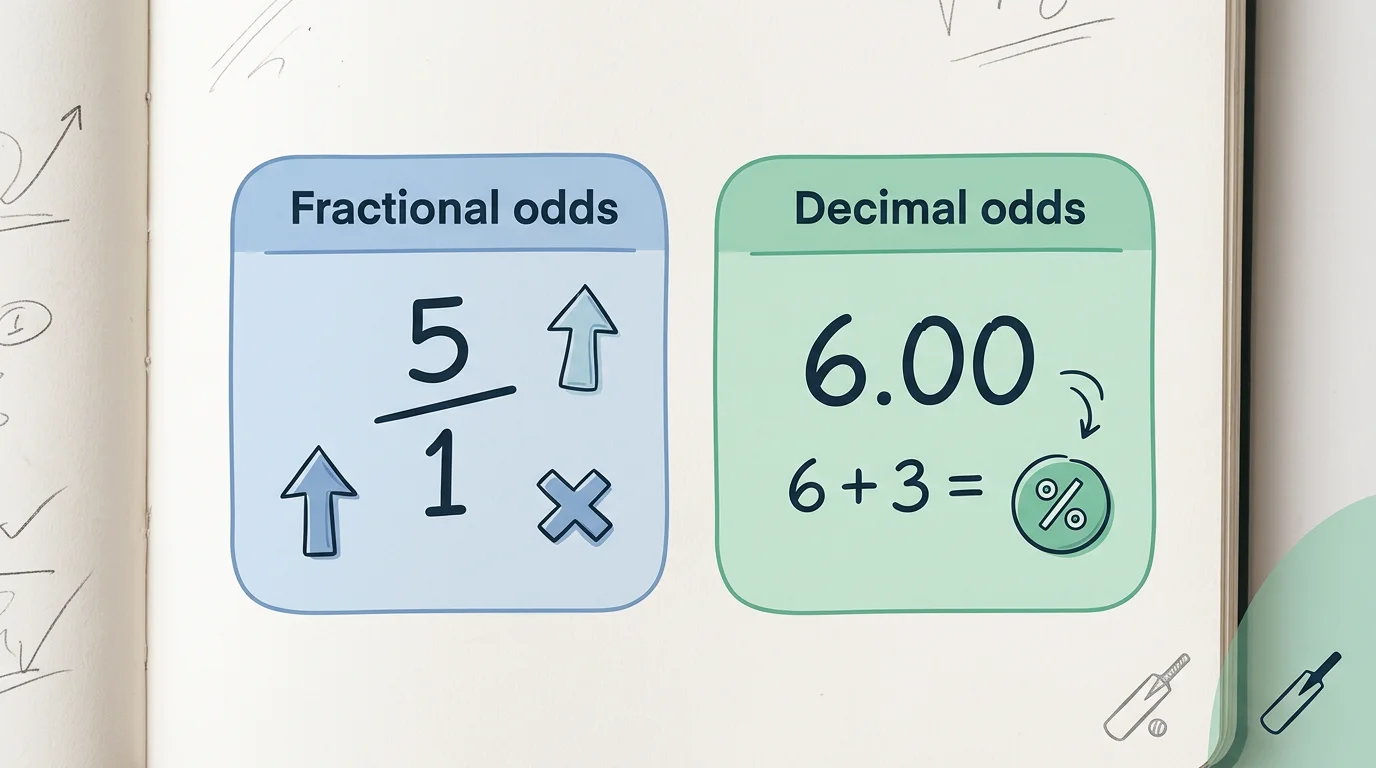
Odds are a way to express a price. In UK sports betting you will most often see fractional odds, but many sites also let you switch to decimal odds. This page explains what both formats mean, how to calculate the return on a simple stake, and how to read “implied probability” without treating it as a prediction.
This guide is written for everyday users. It does not tell you what to bet on and it does not try to persuade you to place a bet.
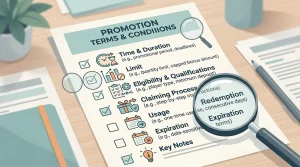
Once you understand how to calculate your potential returns, it is highly recommended to review the latest betting bonuses and promotions to maximize your initial deposit safely.
Analyzing Implied Probability in UK Betting Odds
Whatever the format, odds are mainly used to answer two practical questions:
In practice, ask: If I stake £X and I win, roughly what do I get back? Also ask: How likely does this outcome look according to the price? This second part is only an indication, not a forecast.
Odds are not a promise. They can change before the event starts, and in live betting they can move quickly. That is normal for a market price.
Fractional odds in plain English
Fractional odds are written like 5/2, 7/4, 11/10 or 1/3. A simple way to read them is:
Profit means that for every b units you stake, you win a units of profit. Return means your total return is profit + your stake back.
Example: at 5/2, for every £2 staked you win £5 profit. If you stake £10, the profit is £25 and the total return is £35.
When the fraction is below 1 (for example 1/3), the profit is smaller than the stake. At 1/3, a £3 stake wins £1 profit (total return £4).
Decimal odds: one multiplier
Decimal odds are written like 1.40, 2.75 or 6.00. They are often the simplest format for quick maths because the number is a multiplier:
Use this as a quick rule: Total return = stake × decimal odds, and Profit = stake × (decimal odds − 1).
Example: at 2.75, a £10 stake returns £27.50 in total. The profit part is £17.50.
Quick conversion between fractional and decimal
Many betting sites let you choose how odds are displayed. If you are comparing prices across screens, it helps to know the basic conversion:
For fractional → decimal, use decimal = 1 + (a ÷ b). For decimal → “fractional style”, the profit part is (decimal − 1), which you can express as a fraction if you want.
Example: 7/4 becomes 1 + (7 ÷ 4) = 2.75. And 2.75 corresponds to a profit part of 1.75, which is the same as 7/4.
You do not need perfect fraction reduction to understand the price. Most sites show both formats precisely anyway.
UK shorthand you may see: evens, odds-on and odds-against
UK betting screens often use a few bits of shorthand that can be confusing at first:
- Evens (sometimes written as EVS or 1/1) means you win the same amount of profit as your stake. A £10 stake wins £10 profit (total return £20).
- Odds-on means the fraction is below 1 (for example 4/5 or 1/3). The outcome is priced as more likely, so the profit is smaller than the stake.
- Odds-against means the fraction is above 1 (for example 6/4 or 5/2). The outcome is priced as less likely, so the potential profit is larger than the stake.
These labels are only a way of describing the price. They do not tell you whether a bet is “good” or “bad”.
Implied probability: a useful check, not a prediction
Because odds are a price, you can turn them into an implied probability. This can help you sanity‑check a market (“does this outcome look like a 1‑in‑3 chance or more like 1‑in‑10?”) but it is not the same thing as a true probability.
For a single outcome, the common conversions are:
From decimal odds, implied probability = 1 ÷ decimal odds. From fractional a/b, implied probability = b ÷ (a + b).
Example: decimal 2.00 implies 1 ÷ 2.00 = 0.50 (50%). Fractional 5/2 implies 2 ÷ (5 + 2) ≈ 0.286 (28.6%).
Important: betting markets normally include a built‑in margin. If you add implied probabilities across all outcomes in a market, the total can be above 100%. That is one reason implied probability should be treated as “what the price suggests”, not “what will happen”.
Worked examples you can copy
The table below uses a simple £10 stake. “Return” includes your stake. “Profit” is the amount on top of your stake. Implied probability is rounded and based on the price only.
| Fractional | Decimal | Implied probability | Profit on £10 | Total return |
|---|---|---|---|---|
| 1/2 | 1.50 | 66.7% | £5.00 | £15.00 |
| 10/11 | 1.91 | 52.4% | £9.09 | £19.09 |
| 6/4 | 2.50 | 40.0% | £15.00 | £25.00 |
| 5/2 | 3.50 | 28.6% | £25.00 | £35.00 |
| 8/1 | 9.00 | 11.1% | £80.00 | £90.00 |
If a market has multiple outcomes (for example, win/lose/draw), avoid comparing implied probability across different markets unless you are sure the market rules and settlement are the same. A small difference in how a market is defined can matter more than a small difference in price.
Why odds move (without getting into tactics)
Odds can change for several ordinary reasons:
- New information becomes public (team news, pitch conditions, weather, or changes in availability).
- Market demand shifts as money comes in on different outcomes.
- Risk balancing inside a betting business: prices may adjust to manage exposure.
- Live betting updates as the match situation changes ball by ball.
This is why it is useful to understand the maths of odds: you can recognise what a number means even when it changes.
Common mistakes when reading odds
- Mixing up profit and return. Fractional odds describe the profit part; decimal odds directly give the total return multiplier.
- Comparing different markets. Two prices might look similar but apply to different rules (for example, different match formats or settlement terms).
- Ignoring terms that affect settlement. Some markets have extra conditions (dead heats, tie rules, abandoned match rules). If you are unsure, read the market rules on the site before staking.
- Letting the number feel like a forecast. Odds are a price with a margin, not a guarantee.
A short safety note
Odds can make betting feel like simple maths, but it is still gambling. If it stops being fun or starts to feel hard to control, see Safer gambling tools and support for practical options and help resources.
For daily match analysis and the most competitive prices, always check our premier UK cricket betting platform before placing a wager.